Thursday, 31 October 2013

Thinking Method: The PMI Approach (Part 1 of 2)


Exhorting people to take a balanced view is not very effective. The exhortation wears off almost at once. Most people even claim to take a balanced view all the time. In practice they do not.
So the first simple thinking tool is concerned with a broad scan. The tools have to be practical and usable. There are certain aspects of the design of thinking tools which may not be obvious at first sight but do have a reason for being there.
De Bono said in an interview, “I once asked seventy very bright young adults to write an essay on the suggestion that marriage be a renewable five-year contract. Sixty-seven of them wrote their opinion of the idea in the first sentence of their essay and then used the rest of the essay to support that opinion. There was no exploration. That is sometimes the style that is recommended for essay writing.”
In addition he mentioned, “One of the biggest faults of thinking is the use of it to back up an opinion that has already been formed (by first impression, slight thinking, prejudice, or tradition). This is one of the major faults of the intelligence trap, and highly intelligent people suffer from the fault eve more than others. They can so ably defend the point of view that actual exploration of the matter seems a waste of time. If you know you are right and can demonstrate it to others, then why explore the subject?”
The PMI is a powerful thinking tool that is so simple that it is almost unlearnable — because everyone thinks he or she uses it anyway. The letters are chosen to give a nicely pronounceable abbreviation so that we may ask ourselves, or others, to ‘do a PMI’.
stands for Plus or the Good Points
M stands for Minus or the Bad Points
stands for Interesting or the Interesting Points
The PMI is an attention-directing tool. In doing a PMI you deliberately direct your attention first towards the Plus points, then towards the Minus points and finally towards the Interesting points. This is done in a very deliberate and disciplined manner over a period of about 2 to 3 minutes in all. The PMI sets the mood of objectivity and scanning as what will be described later on.

De Bono was once asked to demonstrate his CoRT lesson (The PMI Approach) to a group of educators in Sydney, Australia. Before starting the lesson he asked the group of 30 boys (age 10-11) to tell him what they thought of the idea of each of them receives $5 a week just for going to school. All of them loved the idea and began to tell him what they would do with the money (buy sweets, comics, toys, etc.). He then explained the PMI and asked them to go through Plus, Minus, and interesting points with regard to the $5 suggestion. They were to do this by discussion in groups of five. After three minutes a spokesman for each group gave the output. Many points were turned up.
  • The bigger boys would beat them up and take the money.
  • Parents would not give presents or pocket money.
  • The school would raise its charges for meals.
  • Who would decide how much each age level was to get?
  • There would be quarrels about money and strikes.
  • Where would the money come from?
  • There would be less money to pay teachers.
  • There would not be any money for the school to buy a minibus
At the end of the exercise the class was again asked if they liked the idea. Whereas thirty out of thirty had previously liked the idea, it now appeared that twenty-nine out of thirty had completely reversed their view and now disliked the idea. What is important to note is that a very simple scanning tool, used by the youngsters themselves, had brought about this change. De Bono made no further intervention and never said a word about the subject matter itself.
Suppose you were asked to do a PMI on the suggestion that all cars should be painted yellow. Your output might be something as follows:
P
  • easier to see on the roads
  • easier to see at night
  • no problem in deciding which colour you wanted
  • no waiting to get the colour you wanted
  • easier for the manufacturer
  • the dealer would need less stock
  • it might take the ‘macho’ element out of car ownership
  • cars would tend to become just transport items
  • in minor collisions the paint rubbed off on to your car is the same.
M
  • boring
  • difficult to recognize your car
  • very difficult to find your car in a car park
  • easier to steal cars
  • the abundance of yellow might tire the eyes
  • car chases would be difficult for the police
  • accident witnesses would have a harder time
  • restriction of your freedom to choose
  • some paint companies might go out of business
I
  • interesting to see if different shades of yellow arose
  • interesting to see if people appreciated the safety factor
  • interesting to see whether attitudes towards car changed
  • interesting to see if trim acquired a different color
  • interesting to see if this were enforceable
  • interesting to see who would support the suggestions
Carrying out the process is quite easy. What is not easy to direct attention deliberately in one direction after another when your prejudices have already decided for you what you should feel about an idea. It is this ‘will’ to look in direction that is so important. Once this is achieved then the natural challenge to intelligence is to find as many P or M or I points as you can. So there is a switch. Instead of intelligence being used to support a particular prejudice it is now used to explore the subject matter.
At the end of the exploration of emotions and feelings can be used to make a decision on the matter. The difference is that the emotions are now applied after the exploration instead of being applied before and so preventing exploration.

Wednesday, 30 October 2013

Thinking Is A Skill


I have managed to study Edward De Bono’s Thinking Course. De Bono’s the person responsible for creating the concept of Lateral Thinking and has made enormous contributions in the field of perception and thinking. 
Is thinking something natural to us like walking, eating, breathing, and that it is already fixed or is it a skill that we can improve, refine, and fluid that we can influence it through practice. De Bono suggests that the latter gives more justice to thinking because it is not a matter of IQ that determines if one is a good thinker or not; it is one’s desire to hone it as any other skill that requires practice. 
Intelligence vs. Thinking
Intelligence has been known to be of high regard, and institutions give emphasis on the IQ part of an individual in recruiting and putting them in positions fit of their intellectual quotient. 
Intelligence.
Such a big word, and for someone to be labelled as intelligent would put him/herself in high regard. Yes. High regard to the extent that one is put up to expectations. What about Thinking? Thinking is different from intelligence in such a way that thinking provides freedom in committing mistakes than just being correct all the time. It is more natural to think, yet most people prioritize intelligence over thinking — which is also encouraged by educational systems.
However, in actuality, people with high IQs tend to be the worse thinkers according to De Bono. Because they commit themselves into an expectation that is detrimental in its development.
Intelligence Trap
Intelligence becomes constricted. It becomes defensive in its stance and view, that if an intelligent person were to answer, there are expectations of “I must be like this,” “I must be right,” and even not answer at all in fear of failing to live up to the expectation of being perceived as intelligent. 
That is why there are studies conducted about how to raise a child right, by praising them for their efforts and not because they are intelligent. Praising them of their intelligence puts them in a defensive mode and becomes lazier instead, using excuses in order to hide their laziness. It’s evident in strategic learners. Who would not want to be perceived as intelligent and who would want to be dethroned of that perception of them?
Slow Thinking
Since the processing part of thinking has been given more importance than the perception part, people are then quick to jump to answering questions. Especially in the field of Mathematics, the one who can answer equations the fastest, by being familiarized with patterns, is considered to be brighter. 
Being able to process quickly is great in itself, but there are times one must slow down their thinking. One does not have to be so hot all the time in thinking. The purpose of the brain is to think in order not to think anymore. It creates patterns, heuristics, and schemas in order to quicken the thinking process. 
However, that is where the folly lies. People are quick to think that they miss the essence of things. One is so fixed in the current pattern that it has imprisoned itself, unable to branch out to new ideas. 
Using the PMI Approach
De Bono suggests of an approach to break away from the folly of thinking quickly and being trapped in cycle of patterns. It is the PLUS, MINUS, & INTERESTING approach. Which in the old pattern, one only wishes to go in a straight line of thinking and if it doesn’t seem to be effective, one relies on mistakes, accidents, and insights in order to create new patterns.
By using the PMI approach, one enables to sort out the positive aspects of a situation, the negatives, and even the interesting which leads to innovation. The Plus aspect is what’s always considered in the usual clashing of ideas method, and that is why two parties lead to arguments to refute an idea and overrule that idea over the other; which isn’t effective at all. It is by restructuring your old patterns that you can be able to rise up from the convention and provide innovation from the old to new ideas.
The next time you think about Thinking, If you’re to be considered an intelligent person, would that stop you from committing mistakes? Be wary of the intelligence trap because I’ve seen countless of dean’s lister, honor rolls, and bright people who succumbed to this as their pitfall. Even the most intelligent will refuse to think in the face of uncertainty in fear of being mistaken. Be the thinker who will plow onwards in the face of this uncertainty, a mistake is just one way of learning new ideas.
Which leads me to the saying of Henry Ford:
“Thinking is the hardest work there is, which is probably the reason why so few engage in it. 

Thursday, 24 October 2013

Is It Really A Speckled Band?


When I first read the title of one Doyle’s story entitled, “The Adventure of the Speckled Band” I thought that it was literally a headgear which was the singular cause of a person’s death, apparently it wasn’t. It was far more the result of reasoning born out of insufficiency, which became the obstacle of Holmes in his deductions that put him in the wrong scent. “A band, a speckled band!” cried the woman before she met her demise. A folly that caused a person’s death, was it really a speckled band?
Early parts of the short story weren't as intriguing as the other adventures of Sherlock Holmes, but what captured my attention was the action of Holmes’ client to be in their residence quite early. A person, specifically a lady, to be seeking help so early in the morning, quarter past seven in the morning, something must be amiss. And there was really a problem, the mysterious death of the client’s sister who’s engaged, but died a few days before her marriage. It is one of the most singular of cases, which even the police didn’t even believe the client’s story, for her sister died without any hint of struggle, bruises, blood, or any of the sort, but the woman was said to be writhing in pain before she choked and made her last breath.
I was even dumbstruck myself in figuring out how did the woman met her doom and with her last words “The Speckled Band,” which is quite a mystery. It was, however, a folly in the story; the speckled band was found to be a serpent that seemed like a speckled band. It proved to be a difficult case for it smoked the real facts. And the data Holmes gathered was not enough for him to build his theories. He can’t easily make a hypothesis about it.
It is quite so relatable, for I had my share of jumping to conclusions without even acquiring facts before formulating my theories. It is a capital mistake. Quoting Holmes in the story:
"I had come to an erroneous conclusion, which shows, how dangerous it always is to reason from insufficient data." —Sherlock Holmes, The Adventure of the Speckled Band
Even worse, guessing, which is an irrational way of thinking. I have made mistakes out of guesses; two things that I thought were a speckled band, for I was too hot in forming my conclusions even without solid data. Much more that I’m in the field where I work my observational skills 24/7 and the Profiling which I’m pursuing to master. It is not wise to rely on guessing. It’s a capital sin in my profession. That is why being a student of behavior and mental processes, one must be knowledgeable enough to avoid the folly of guessing.
I am certain that I am not the only one who succumbed to this, but being aware of this recklessness would save one from a life of conflict out of wrong assumptions and dim-lighted guesses. Next time you think that something is amiss, will you ever make the mistake of guessing of it as a mere speckled band?

Tuesday, 15 October 2013

Establishing Rapport: I Am On Your Side


To establish rapport is to establish a relationship of mutual trust. Rapport plays an important role when detectives question witnesses. Establishing rapport is the first step to getting people to open up to you. Certain useful methods exist for persuading or befriending someone.
The simplest method is [to eat something together.] People open up more easily when they are performing [instinctual] actions rather than [social] ones. Just before they sleep or just after they wake, in the toilet, and during a meal, people are psychologically defenseless. This is the reason groups of school friends naturally [eat lunch together], and the reason two people [have a meal together] at the start of a blind date.
More specific conversation methods also exist. The technique of [repeating someone’s words] to show you are listening attentively is called [backtracking]. When using backtracking, it is not advisable to parrot their words exactly. It is better to respond using slight variations. This gives them the feeling you are [listening closely].
Most people can talk comfortably and continuously about things they like. They may more easily open up to you if you figure out [what they like] and ask them questions about it. 
Another useful method is imitating the person’s actions. This is called [mirroring]. These methods send the message [I am on your side], on a subconscious level. They are useful aids in establishing rapport and gaining access to someone’s heart.

Life is a Chess


Life, it is full of decisions to make and choices that we are to take. It’s a game of strategy and tactics, on who can make astute decisions emerges the victor. In every move, lies a path that can take you deeper into a particular circumstance; it is not how which path you want to take, but how deep do you want to go. Sometimes when we are compelled to move, we move half-heartedly because of the thought that there’s no taking it back. 
Do we begin to tremble in fear in the face of this uncertainty? Or do we pursue even further, committed to our decisions, and tread the unknown—such is the nature of chess, that for every move lies a corresponding chain of action. 
Everyone is a chess piece in life, but not all can be a chess player. People are not logical beings, but psychological ones; tied to their emotions, they succumb to this kind of a drug. A chess piece is in itself enclosed in a box along with other chess pieces, only do they come out when they are needed as mere tools for serving an end and be taken back in darkness when they have served their purpose. It takes a chess player to rise above their emotions and have clarity of mind as they go along, although they have emotions too, they know the equilibrium of making decisions, balancing out the pros and cons, strategizing before committing
The world itself is a giant chess board, and it is far from a question of moves, but a question of us being a mere chess piece or the chess player. Either we are below awareness or conscious of everything. And that is a question we must ponder, further reasoning out our judgments, as we find ourselves to be enlightened as the chess player.

Sunday, 13 October 2013

Best Way To Get Your Password: Social Engineering

In 2003, Ebay users received an email that their account were about to be suspended unless they update their credit card information. The attacker had set up a similar looking website in order to trick the users that they were accessing the legitimate website. A number of people had their credit card information compromised. Information were obtained without the hacker even trying to crack Ebay's servers.

Hello there buddy. I just need your credit card information.

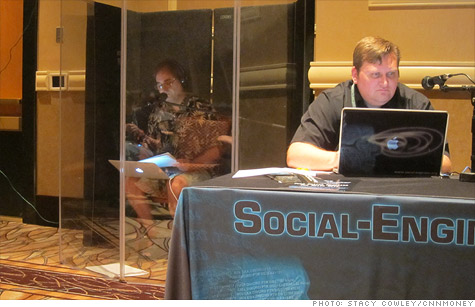
In 2012, a hacker in a devcon event tried to hack a Wal-mart executive in just 20 minutes. He got every detailed information about the executive within that time span just by using his social engineering skills and a little bit of technical tools of the trade. The executive was compromised when he was called and he gave out all the information that the hacker needed. Computer OS version, Web Browser version and Anti Virus Software. Finally he was asked to fill out an online survey form which completed the exploit. This was done at devcon with hundreds of people watching the attack as it happened.


Yes Sir, please click that link. Thank you very much. We're done.

These incidents were made by a hacker which had no direct access to the system's server. This method is by far, easier and more practical because it gave the hacker a broader access to the victim's profile which may directly relate to how he secures his/her online identity. Cracking a system with hacking tools may take time and may not even be successful at worst.

One of the greatest hackers of all time, Kevin Mitnick (who later turned into a security consultant) was, at one time, the most wanted man in America. He gained unauthorized access to various network and systems by using his social engineering skills. He believed that the weakest link in computer security is the human element.

In order to protect yourself from such attacks, you must first know thy enemy.


Commonly Used Social Engineering Techniques

Phishing
Method of acquiring usernames, passwords, credit card information etc. by sending fraudulent emails to users and redirecting them to a non-legitimate website which may collect personal information from them.

Quid Pro Quo
It means "Something for Something"

  • An attacker calls random numbers at a company, claiming to be calling back from technical support. Eventually this person will hit someone with a legitimate problem, grateful that someone is calling back to help them. The attacker will "help" solve the problem and, in the process, have the user type commands that give the attacker access or launch malware.
  • In a 2003 information security survey, 90% of office workers gave researchers what they claimed was their password in answer to a survey question in exchange for a cheap pen. Similar surveys in later years obtained similar results using chocolates and other cheap lures, although they made no attempt to validate the passwords
Baiting
This is also known as the physical or the real world Trojan Horse. It uses physical media such as USB, CDs and other removable drives as an attack vector. This kind of attack relies heavily on malware and other malicious codes in order to carry out its goal. This may also trigger a wave of infection, affecting a large number of victims in a short span of time.

Now that we have known thy enemy, we can now protect ourselves from the threat.


Yes we can put him out of work.

How To Protect Yourself From Social Engineering Attacks

Password
  • Create a strong and unique password by using combinations of upper and lowercase letters, characters and numbers. 
  • Do not use easy to guess passwords such as your dog's name or your mothers maiden name.
  • Do not use the same password for multiple sites.
Browser Security
  • Always log out of devices which you do not own.
  • Regularly update your web browsers. They regularly do updates in order to patch malicious exploits.
  • Always look for the HTTPS when logging on websites that require personal information.
  • Do not click on unfamiliar links.
Computer Security
  • Regularly scan your computer for viruses.
  • Do not install any unfamiliar applications which may execute malicious codes on your operating system.
  • Unless you know what you are doing, steer away from pirated software.
  • Do not entrust the security of your computer to strangers.
  • Trust only certified technicians when it comes to your PC's maintenance or repair.
Remember, with a little bit of common sense and technical know-how, you can protect yourself from malicious hackers who exploit the human weakness in order to get personal information for their own gains.

Stay tuned and please like our facebook page in order to receive a daily stream of information.


Reference links:


Friday, 11 October 2013

Personality & Self-Discovery


Personality.
What is Personality?  According to Wikipedia, “It is the particular combination of emotional, attitudinal, and behavioral response patterns of an individual.” The word pattern itself in the description, describes personality as something that may be predicted.
I’ve always been fascinated about the idea of “self-discovery,” because it’s like an untapped goldmine waiting to be found; even back then, things that are about personality and even autograph books were my sort of thing, I like describing what I like, my likes and dislikes, my favorite color, and all that jazz. The idea of sharing those information is quite gratifying and what more is that as you go along you get to find yourself even deeper amidst the ideas that you share, like insights pop out of nowhere seeming that it was done by some unknown divine force. 
Personality fascinates me the most; I have this great need to just analyze the behaviors of others and see the meaning behind their behavior. That need is what pushed me to pursue Psychology and I must say, I’m enjoying every bit of my education, though some days are boring, but I motivate myself from day to day if needed (hey, motivation is like bathing, we should do it everyday). 
Journey of Self-Discovery
I’ve come to different fields of interests ranging from poetry, music, sports, and dancing but I realized, all those were just a means to an end, that end was my journey of self-discovery. In every field that I pursue, I’ve always wanted my own classification like if I’m in music, what type of musician am I? What’s my genre? What instrument do I play? Same goes with poetry, what type of poetic style should I be using (I used free verse and villanelle); then I got into dancing and I was so eager to have my own distinction from other dancers and so I chose Popping as my specialty. For every field that I’ve pursued, I wanted to have my own niche and distinction. 
Self-discovery, the idea of knowing more about yourself, i.e., the strengths, weaknesses, quirks, habits, and the like are what I found to be the most enjoyable. Some field may be in the exploration of our universe, some explores the vastness of our ocean’s deep, and what I found to be the best to explore is the mind and the personality that goes with it.
Personalities are Puzzles
Everyone is unique and yet they are all the same. What I see are not mere personalities on people, but puzzles that can somehow be solved to some extent. Our personality manifests throughout our whole being, from our preferences on things, the way we choose to dress ourselves, our way of laughing, how we sneeze, our belongings, and even the spaces we live in speak a lot of our personality. All things that surrounds us which are under our control and subjected by our preferences are a reflection of who we are inside. 
I perceive personality as a jigsaw puzzle, that new pieces are being shown the more you interact with a person. And you can only do so if you’d be well enough to share your own, it’s a transaction that both parties are benefitting. The degrees of knowing would depend on the training of the person, if one would train his faculties to discern the underlying patterns based on principles, one can put great amount of certainty and accuracy on their profile, compared to someone who’s not trained. 
I’m still dubious of why people can’t invest time on discovering themselves; the earlier they put effort into it, the smoother their lives will be and they would know their limits and to how long can they stretch their boiling point. A lot of benefits can be earned by pursuing this matter, even if you’re not in the field of Psychology, you can still learn more about yourself through your own way. 
That’s why people have problems coming out of the blue, not knowing the root of the problem must be one of the hardest things to come by, a problem can be provided by a solution once it’s recognized, but a problem that you don’t know what’s causing it is such a pain. Little you know, it might be you who’s the source of it, which you usually bring up but not aware because it happens unconsciously. I think you’ve encountered of this line before, “I need to find myself first,”  which arises from the lack of knowledge of one’s self. 
People look on different places, only to find in the end, that the answer lies within themselves all along. Have that interest for self-discovery and make yourself your own puzzle, be ever hungry for it as the nature of your curiosity dictates.
There’s this saying, “The unexamined life, is not worth living.” if that should ever be the measure of wealth, those who have invested in knowing themselves with greater depth must be utterly rich! 

Friday, 4 October 2013

Body Language: Mirroring

Mirroring in Psychology is the behavior in which one person copies another person while in social interaction with them. It may include miming gestures, breathing, posture, pace of speech, direction of feet pointing, expressions, and choice of words. Mirroring is often observed among couples and close friends. It can also be used to initiate rapport with a person.


In the image, as an example, Hannibal demonstrates postural mirror-image mirroring in an attempt to employ rapport on his client. It is indeed called mirror image as imitating movements when you would see yourself in the mirror. The client’s right leg over left while Hannibal’s left leg over left is a good demonstration of a postural mirror-image mirroring. 
It’s beautiful how the creators of Hannibal employed Psychology in it, because Hannibal Lecter is a psychiatrist in Hannibal, utilizing the branch of body language even in the most subtle manner such as those which may come unnoticeable, but would be valuable and effective. 
Types of Mirroring
     Crossover mirroring occurs where one person’s movement is matched with another type of action, sound, or different movement.
     Direct mirroring occurs where a person is facing right on at another. It is used by lovers, people with high familiarity or interest in one another such as opponents in a contest.
     Postural mirror-image mirroring occurs where one person’s left side “matches” the other person’s right side shows strong rapport and typically affinity or empathy and increasing your own synchronicity with someone can also smooth conversation.
     Incongruency can be mirrored for rapport. If someone says “Great” but looks or sounds downtrodden, a mirroring reply would be to incongruently say “Good” with a similar down attitude like them.

Monday, 30 September 2013

The Link Between Regression & Smoking


The prevalence of smoking reaches in great numbers and nowadays even kids in the age of 12 are already puffing this cancer stick. What makes people smoke? The top 3 reasons that I always get are the following:
1. To alleviate stress
2. Builds instant rapport
3. Smoking is cool (okay, scratch that)
To Alleviate Stress
How do you even alleviate stress by sucking up nicotine and smoke into your system? The effect of the nicotine gives that distinct feel but it makes you even more dependent because it’s addictive. If smoking would be your resort in reducing stress, there are better alternatives.
Builds Instant Rapport
I must say, this is probably the most annoying and yet true. I get left out when my friends smoke because I don’t, and out of nowhere, they get to have instant friends with random strangers. Smoking makes people connect, or the shared action would likely to mirror the stranger’s behavior creating an air of rapport. We can always establish rapport in different ways, but must I suggest not on their cigarette break.
Smoking is Cool
Okay, this is just silly. What made it cool? Oh, because of what the media hyped it up to be. I noticed that people who easily conforms to their own groups would be the ones susceptible to smoking. It’s not just that it is cool, but the people they look up to is acting it out, and this somewhat admiration of that person translates into their behavior. “If I smoke like what popular people do, I get to feel better about myself because at least on the shallowest form, I imitate what that cool person is doing” kind of thing. Really now? 
Aside from the 3, we also have to look at the socio-cultural aspect, starting from the very cell of a society which is the family. We form our habits in the comfort of our own home and with the people who conditions us on the things we do. Some families are okay with smoking and some are not, but the greater the number in the family that smokes, the higher the chance that one in the family will participate in it as well. It’s more about what fits.
But what exactly made the older family members smoke? One would think it’s a chain of inherited habits, but I know people who do not smoke even if being surrounded by smokers. It has something to do with our ego defense mechanisms, specifically Regression.
Regression, according to psychoanalyst Sigmund Freud, is a defense mechanism leading to temporary or long-term reversion of the ego to an earlier stage of development rather than handling unacceptable impulses in a more adult way.
To simply say, you revert back to your childhood behavior where you lacked or overly-indulged in something. Aside from that, it’s closely linked to the psychosexual stages, Oral stage in particular. 
The term Oral Stage denotes the first psychosexual development stage where in the mouth of the infant is his or her primary erogenous zone. 
One becomes Orally fixated when during their infancy, the infant is either deprived or overly-indulged via mouth, having that as the case, it would manifest in the infant’s adult life.
It may very well explain the idea on why people smoke. Linking these two ideas, Regression and Oral Fixation. One of the evident things that backs up this conjecture is the idea of alleviating stress. As what I’ve said earlier and now we come to realize—this is the sole or the first reason why people smoke.
When we are going through something difficult that causes significant increase in our stress levels, our ego defenses are summoned to protect us against the bombardment of stress and anxiety. People, who are orally fixated or wasn’t able to find resolution on that stage, somehow commit regression—in a more subtle and sophisticated way of course—and this is done through smoking; it is socially acceptable in most places, a lot of people are doing it, and there’s an acceptance in smoking that makes people enjoy it. 
The next time you smoke, try to think of the reason on why you do the way you do, why you smoke and what made you to do so. You never know, you may be orally fixated, others would bite their nails, pencils, and even commit oral sex for the most over others, since these are not usually done for the most part, smoking is the viable way to express this oral fixation when they regress. 
I’m not telling you to stop smoking, but being mindful of the reasons on why you smoke (on a psychodynamic perspective) would be a big help when the time comes that you need to quit. The awareness itself would help you tolerate the withdrawal effects when you’re on your way to quitting since dependency of the mind to habitual consumption and intake of chemicals is a difficult feat to overcome.

    Sunday, 29 September 2013

    Five Things You Should Know About Body Language

    Excerpts taken from the book, “What Every Body Is Saying" by Joe Navarro. 
    1. EYES 
    “When we like something we see, our pupils dilate; when we don’t, they constrict. We have no conscious control over our pupils, and they respond both to external stimuli (for example, changes in light) and internal stimuli (such as thoughts) in fractions of a second.”
    “When we become aroused, are surprised, or are suddenly confronted, our eyes open up—not only do they widen, but the pupils also quickly dilate to let in the maximum amount of available light, thus sending the maximum amount of visual information to the brain… Once we have a moment to process the information and if it is perceived negatively… in a fraction of a second the pupils will constrict.”
    “Any decrease in the size of the eyes, whether through squinting or pupillary constriction, is a form of subconscious blocking behavior. And all blocking behaviors are indicative of concern, dislike, disagreement, or the perception of a potential threat.”

    2. SHOULDERS
    “We use shoulder shrugs to indicate lack of knowledge or doubt. Look for both shoulders to rise; when only one side rises, the message is dubious.”
    “Partial shoulder shrugs indicate lack of commitment or insecurity.”
    “If you see a person’s shoulders only partially rise or if only one shoulder rises, chance are the individual is not limbically committed to what he or she is saying and is probably being evasive or even deceptive.”

    3. HANDS
    “Hand steepling may well be the most powerful high-confidence tell. It involves touching the spread fingertips of both hands, in a gesture similar to “praying hands,” but the fingers are not interlocked and the palms may not be touching.”
    “I see women steepling under the table or very low, undermining the confidence they genuinely possess. I hope that as they recognize the power of the steeple as an indicator of self-assurance, competence, and confidence—traits most individuals would want to be recognized as possessing—more women will embrace this gesture and display it above the table.”

    4. THUMBS
    “Often seen with high-status individuals, the thumb sticking out of the pocket is a high-confidence display.”
    “When individuals carry their thumbs high, it is a sign that they think highly of themselves and/or are confident in their thoughts or present circumstances. Thumbs up is another example of a gravity-defying gesture, a type of nonverbal behavior normally associated with comfort and high confidence.”
    “Feelings of low confidence can be evidenced when a person (usually a male) puts his hands in his pocket and lets the fingers hang out on the side… this signal says, ‘I am very unsure of myself.’”

    5. LEGS
    “Leg crossing is a particularly accurate barometer of how comfortable we feel around another personWe normally cross our legs when we feel comfortable. The sudden presence of someone we don’t like will cause us to uncross our legs.”
    “When people sit side-by-side, the direction of their leg crosses becomes significant.”
    “Here’s an interesting feature of leg crossing. We usually do it subconsciously in favor of the person we like the most.”

    There you have it. The five things you should know and pay attention to when you’re studying body language. Focusing on these five will help you pay attention to even the most subtle of movements.

    Reference

    Navarro, J. (2008). What Every BODY is Saying. America: HarperCollins.